Can a Baby Be Born in Space? Scientists Issue Stern Warning Over ‘Space Reproduction’
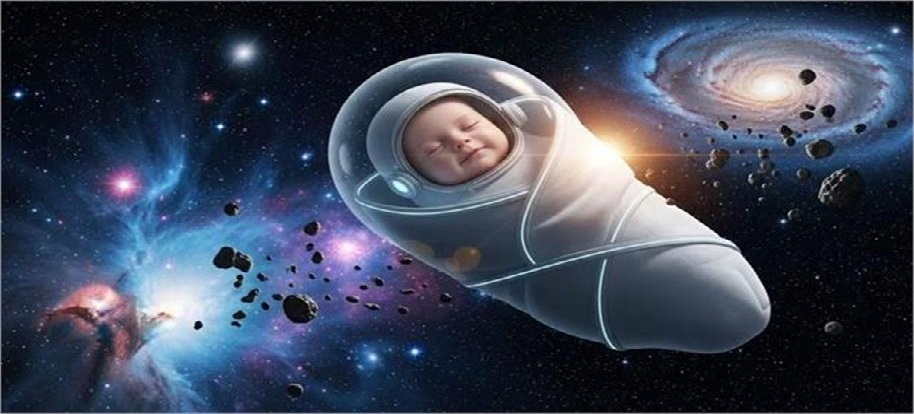
As humanity edges closer to becoming a multi-planetary species, with plans for lunar bases and Mars colonies, a fundamental question arises: Can we safely reproduce in space? A groundbreaking study involving nine international experts has raised significant alarms regarding “Space Reproduction.” Published in the journal ‘Reproductive Biomedicine Online’, the report suggests that while the technology for reproduction in space is advancing, the biological and ethical risks remain perilously high.
The era of space being just a “workplace” for astronauts is evolving into a commercial frontier. With private space tourism on the rise and long-duration missions becoming common, reproductive health is no longer a theoretical concern but a practical necessity. However, the harsh environment of space poses existential threats to human embryos and fertility.
The foremost challenge identified is Cosmic Radiation. Exposure to high-energy particles in space can disrupt female menstrual cycles and significantly increase the risk of cancer. Furthermore, Microgravity—the lack of Earth-like gravity—is detrimental to fetal development, particularly affecting bone structure and organ formation. The disruption of the Circadian Rhythm (the internal body clock) also leads to severe hormonal imbalances, making a natural pregnancy and delivery in space highly unpredictable.
Despite these hurdles, science is looking toward Assisted Reproductive Technology (ART). Techniques like IVF (In Vitro Fertilization) and Cryopreservation (freezing eggs and sperm) are being adapted for space environments. Researchers are working on automated systems that could culture embryos in controlled lab conditions even amidst the vacuum of space. Advanced genetic screening could also help identify potential abnormalities caused by radiation during early development.
However, the “Governance Gap” remains a major roadblock. NASA experts Dr. Fathi Karouia and Giles Palmer argue that while the technology might soon be ready, global policy and ethics are lagging. Major questions remain unanswered: Who is liable for an unplanned pregnancy during a mission? What are the legal rights of a child born in zero gravity? If radiation leads to permanent infertility, who takes responsibility? As we dream of settling the stars, these biological and ethical hurdles suggest that “Space Babies” might remain a distant and dangerous reality for now.

- Author
- Storm in Parliament! Opposition Moves No-Confidence Motion Against Speaker Om Birla Over Budget Row February 10, 2026
- Government Cracks Down on Deepfakes: Social Media Must Remove Illegal AI Content Within 3 Hours! February 10, 2026
- Wednesday Rituals: 5 Guaranteed Solutions to Clear Workplace Obstacles and Boost Your Career! February 10, 2026
- The Catch of the Decade! Chapman and Mitchell’s Mid-Air Juggle Stuns the World in T20 WC 2026 February 10, 2026
- 4 Overs, 4 Maidens, 3 Wickets! Lockie Ferguson’s 'Unbreakable' World Record in T20 WC February 10, 2026